

Wise Crowds
Tap the Wisdom of the Whole Group in Rapid Cycles (~25–55 min.)
“Every journey has a secret destination of which the traveler is not aware.”
Purposes
In Wise Crowds, a “client” receives immediate help from “consultants.” This structure engages groups of any size, tapping everyone’s expertise and inventiveness simultaneously. Participants develop their ability to ask for help and sharpen their coaching skills, while quickly forming supportive relationships. Wise Crowds embodies LS Principle #3, Build Trust as You Go.
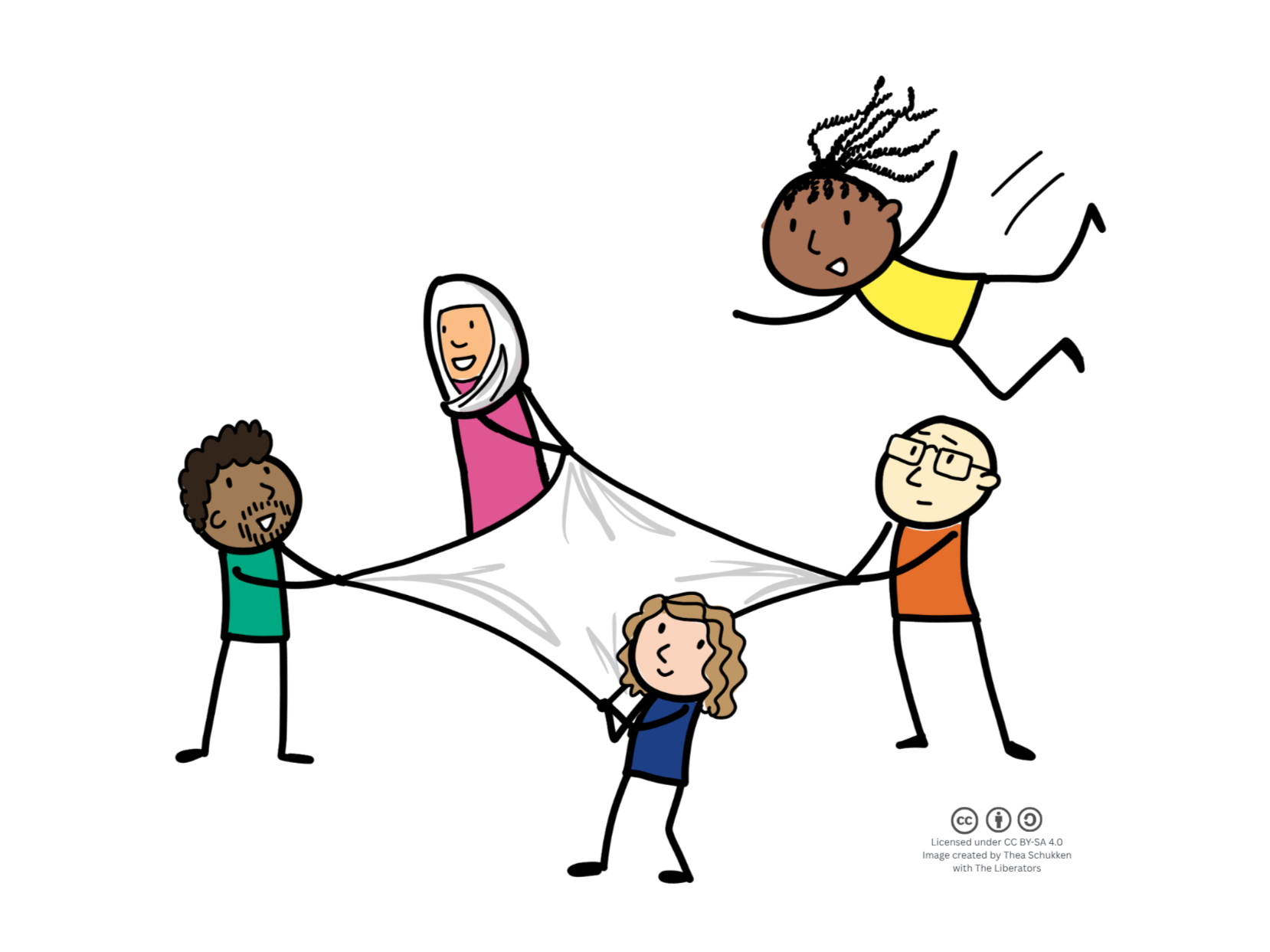
Principle: Build Trust as You Go.
Five Structural Elements—Min Specs
Structuring Invitation
“Each of you will have a chance to be a client sharing your current challenge with your own personal crowd of consultants! Your consultants will have your back for a few delightful minutes.”
Space and Materials
A central group of three to four chairs, with many satellite groups of three to four chairs around them. No tables. [Video spotlight for the central group and breakouts of two to three for satellite groups.] Paper for each participant. Display instructions for participants.
Participation Distribution
Roles include host [tech host], client, consultants, and participants. Minimum group size is ten. Everyone is invited and has an equal opportunity to contribute.
Group Configuration
Small groups, whole group
Steps and Time Allocation
Intro: Share the structuring invitation and display the Wise Crowd Steps (see below). Explain that each client will share their challenge with three consultants while everyone else listens in. Then listeners will break into satellite groups to share their observations. (1 min.)
Individual Reflection: Participants jot down a challenge they are facing. (1 min.)
Select Clients and Groups: Select two to three participants who are ready to be a client and pick one to go first. Invite the client to the front of the room. Ask them to pick three consultants and invite them to the front of the room as well. [Spotlight the client and central consultants.]
Round 1: (20 min. total)
Client Sharing and Q&A. The client takes two minutes to describe their challenge. The central consultants take two minutes to ask clarifying questions. Everyone else observes. (4 min.)
Consultation. The client turns around [turns off their camera] and prepares to take notes. The consultants offer their best advice, building on each other’s ideas and pretending the client is not listening. (7 min.)
Satellite Group Consultations. Everyone else divides into groups of two to three [breakouts] and shares their observations. (4 min.)
All-Together Sharing. Everyone returns to plenary.A few participants share insights that everyone should hear. [Optional: Use Chatterfall.] (4 min.)
Client Sharing. The client faces forward and shares their key takeaways. Remind them to thank their wise consultants! (1 min.)
Additional Rounds: Repeat the steps from Round 1 for the next client(s). Be firm with timing (20 min. per client, up to two more clients).
All-Together Sharing: Everyone returns to plenary. Ask a few participants to share an insight about what Wise Crowds made possible for the clients and consultants. (4 min.)
Taking It Online
Wise Crowds works well online with small adjustments. The client can turn off their video to simulate turning their back, which enhances listening and focus.
Practice Insights
Tips
Encourage participants to ask for help with complex challenges that do not have easy answers. Invite a diverse crowd to help, not just experts and leaders. Invite consultants to critique themselves if they fall into traps such as offering advice too early. If the first round is weak, invite creative adaptations in later rounds.
Riffs and Variations
Use Wise Crowds in small groups (similar to Troika Consulting) by dividing participants into groups of five to six and giving everyone a chance to be both client and consultant. Restrict the consultants to asking questions and forbid them from offering recommendations or advice.
Practical Applications
Wise Crowds can help participants learn from each other and share progress on multisite research projects. It can be used to solve problems associated with a merger with managers of different units or help individuals get advice on improving a relationship.
Optional String
String with Helping Heuristics, 9 Whys, or Talking with Pixies to further support group members.
Attribution
Liberating Structure developed by Henri Lipmanowicz and Keith McCandless. Dig deeper by exploring Clearness committees.
Collateral Materials
Link to supporting materials for Wise Crowds.
Wise Crowds Steps
Round 1
Client Sharing and Q&A (4 min). Client takes 2 minutes to describe the challenge. Central consultants take 2 minutes to ask clarifying questions.
Consultation (7 min). Client turns around [turns off camera] and prepares to take notes. Consultants offer their best advice.
Satellite Group Consultations (4 min). Everyone else divides into groups of 2-3 [breakouts of 2-3] and shares their observations.
All Together Sharing (4 min). Return to plenary.Invite a few participants to share insights they think everyone should hear. [Optional: Use Chatterfall.]
Client Sharing (1 min). The client faces forward and shares their key takeaways. Remind them to thank their wise consultants!
Additional rounds: Repeat steps for 1-2 more clients.
Steps for Wise Crowds
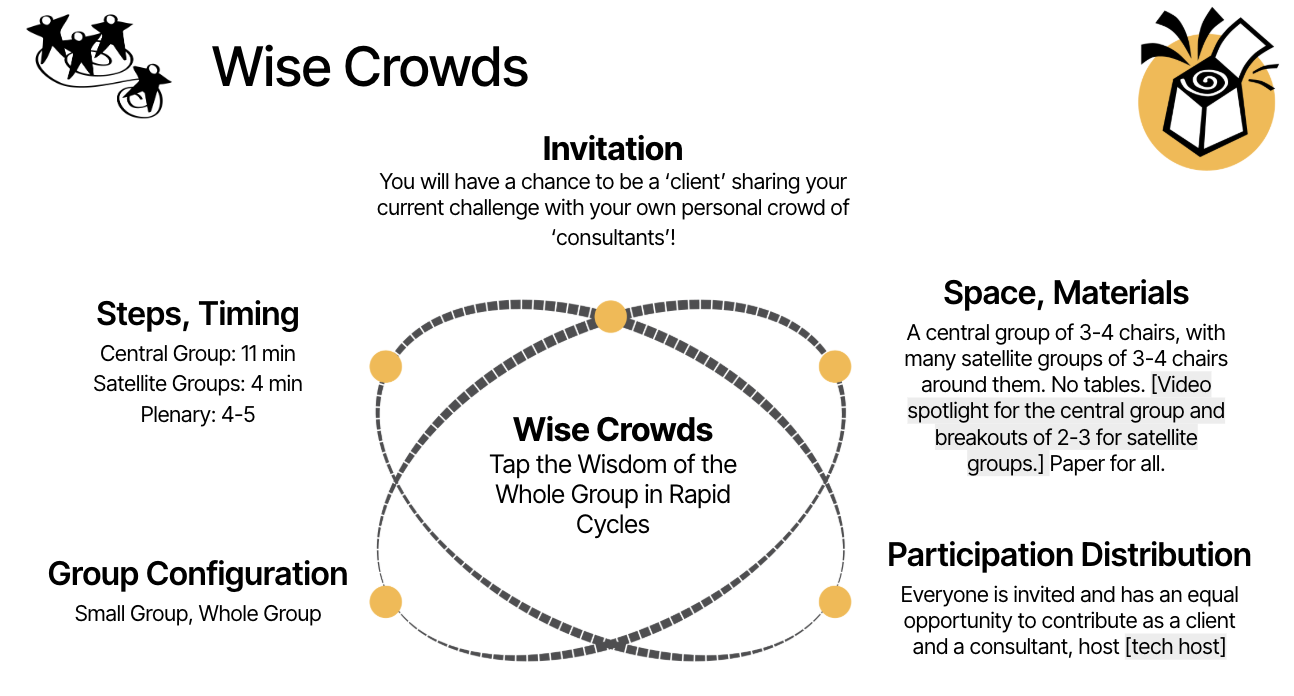
A one-slide overview of the elements of Wise Crowds in the LS constellation format.