

Conversation Cafe
“Any intelligent fool can make things bigger, more complex, and more violent. It takes a touch of genius-and a lot of courage-to move in the opposite direction.”
Engage Everyone in Making Sense of Profound Challenges (~45-75 min.)
Purposes
In Conversation Cafè, small groups engage in productive dialogue using a simple set of agreements and a talking object. This structure encourages deep listening over debate, helping participants make sense of challenges together. As understanding deepens, shared insights emerge that can lead to action and momentum. This structure applies to LS Principle #3, Build Trust as You Go.
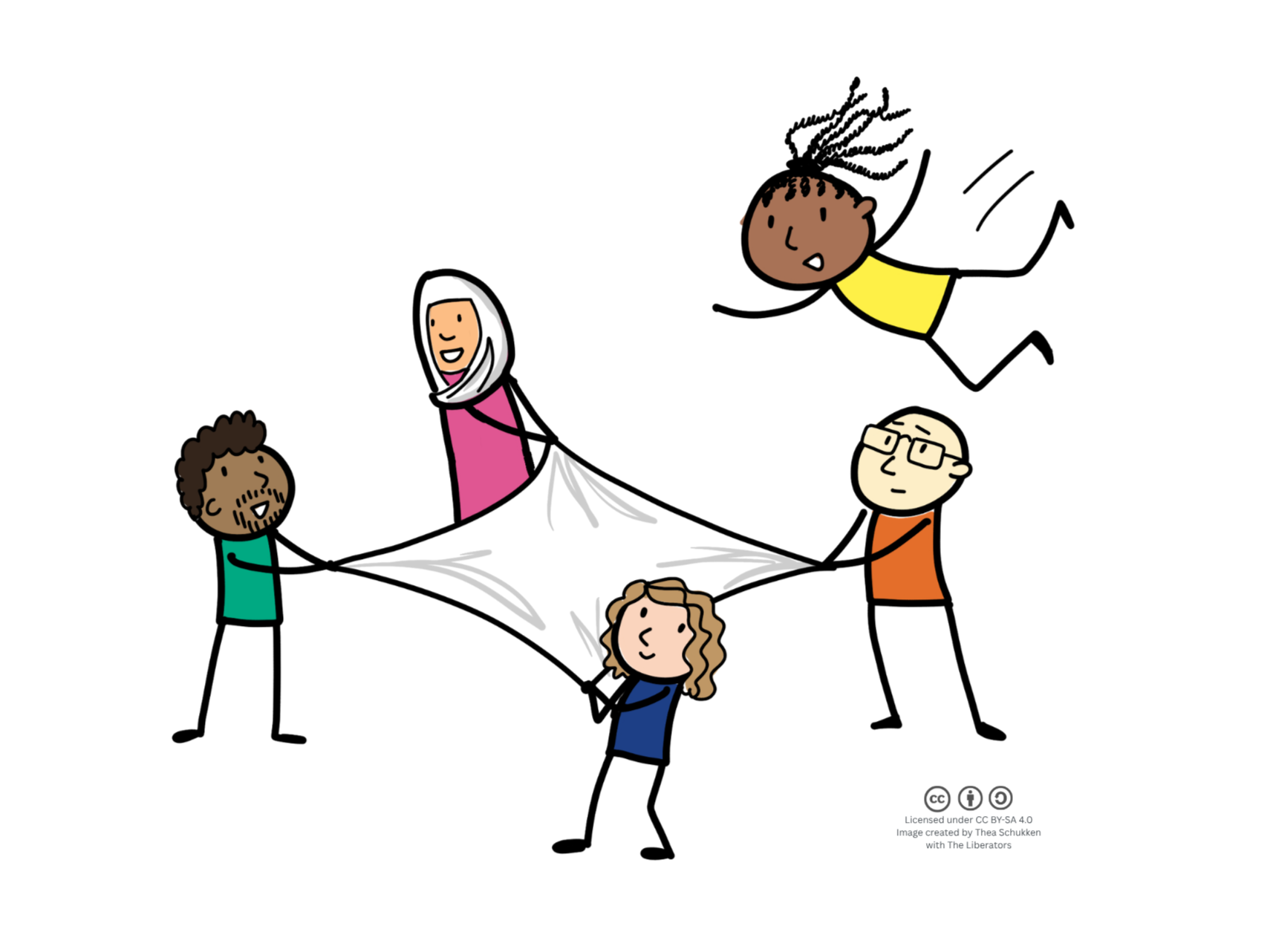
Principle: Build Trust as You Go
Five Structural Elements—Min Specs
Structuring Invitation
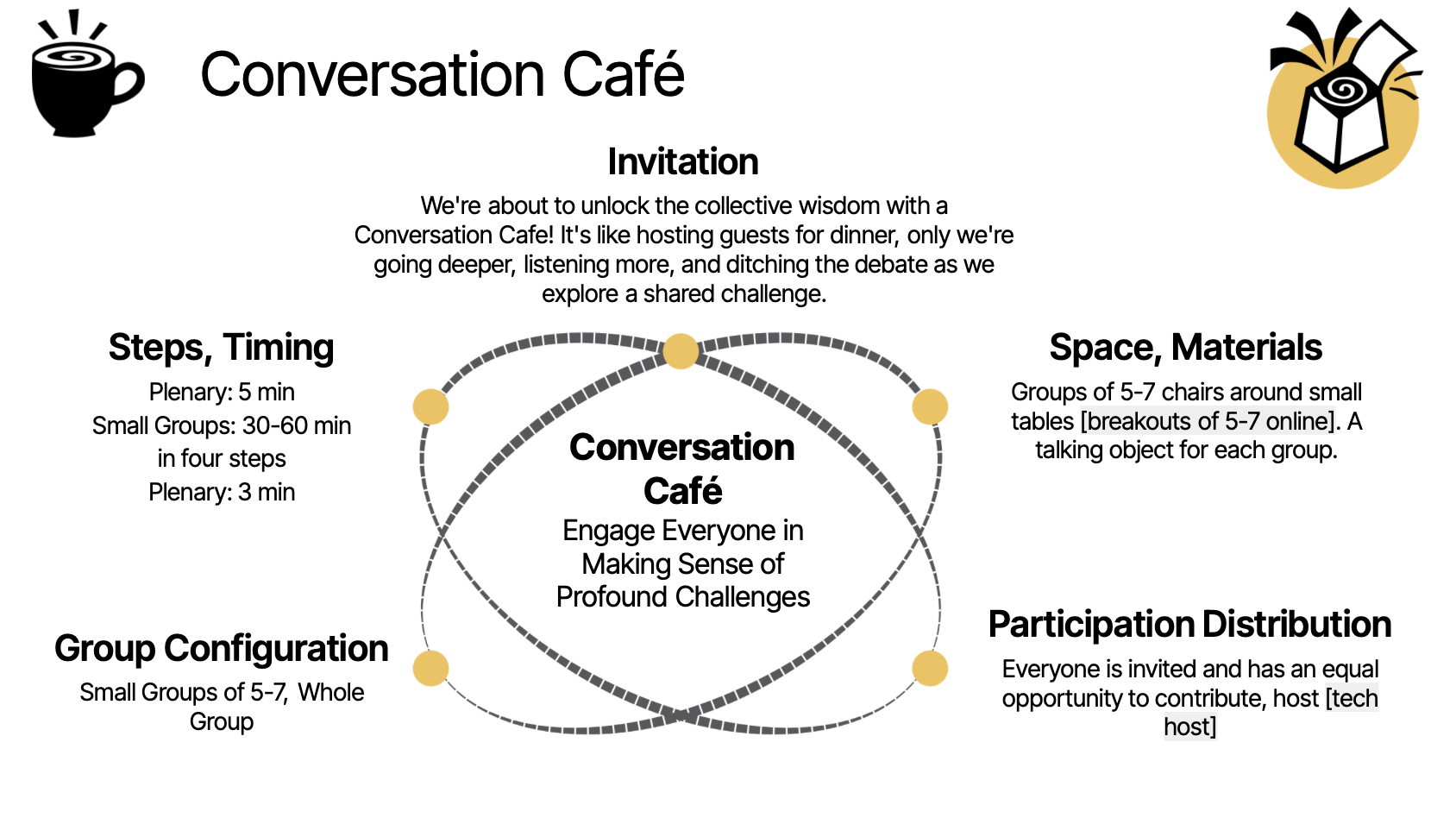
“We’re about to unlock the collective wisdom in this room with a Conversation Café! It’s like hosting guests for dinner, only we’re going deeper, listening more, and ditching the debate as we explore a shared challenge.”
Space and Materials
Groups of five to seven chairs around small tables [breakouts of five to seven]. A talking object for each group (e.g., a talking stick, stone, or art object). Conversation Café Agreements to display.
Participation Distribution
Roles include host [tech host], group hosts, and participants. Minimum group size is five. Everyone is invited and has an equal opportunity to contribute.
Group Configuration
Groups of five to seven, whole group
Steps and Time Allocation
Intro: Share the structuring invitation and identify a shared challenge, ideally as a question. (1 min.)
Instructions: Participants will form small groups and choose a talking object, any object that gives the person holding it the power to speak while others listen. When they’re done speaking, they pass it to the next person. [Online, each participant uses their own talking object and playfully “passes” it to another person.] Introduce the four steps of the conversation café. (3 min.)
First Impressions:Take turns holding the talking object and share your initial thoughts, feelings, or experiences related to our shared challenge. (1 min. per person)
Reflections. After hearing from everyone, share any new thoughts or feelings. (1 min. per person)
Open Chat: Lively conversation time! Use the talking object if it helps with turn taking. (20–40 min.)
Takeaways: Take turns holding the talking object one last time and share takeaways. (5–10 min.)
The Six Agreements: Introduce and display the agreements. Instruct groups to choose a host who will gently remind everyone of the rules if needed, such as if someone is talking too much. (5 min.)
Conversation Café: Participants form groups, choose a talking object, and move through the four steps. [Broadcast a message to breakout rooms to signal each new step or briefly bring them back to plenary for each transition.] (3 min. for setup, 30–64 min. for the café)
All-Together Sharing: Everyone returns to plenary. A few participants share a takeaway from their group’s discussion that everyone can learn from. (3 min.)
Conversation Café
The Six Agreements
Suspend judgment as best you can
Respect one another
Seek to understand rather than persuade
Invite & honor diverse opinions
Speak what has personal heart and meaning
Go for honesty and depth without going on, on, and on

The six agreements used in Conversation Café.
Taking It Online
This works online with no major adjustments. Participants can use their own talking objects and “pass” them by holding them out while saying the next person’s name.
Practice Insights
Tips
Talking objects make a difference in the quality of listening and sense of being heard. Always include them unless doing so would be culturally inappropriate or risk appropriation. Do not assign tasks; Conversation Café is intended for dialogue, not action. If there is a problem, remind everyone of the agreements.
Riffs and Variations
Provide paper or a flip chart [visual collaboration space] for each group to collect insights through text and drawings.
Practical Applications
Conversation Café can make sense of a major setback, handle a topic that raises strong feelings, or explore a new topic or trend that is not well understood.
Optional String
Use Spiral Journal to deepen emergent ideas, or Mad Tea/Calm Tea to expand the range of ideas.
Attribution
Liberating Structure developed by Henri Lipmanowicz and Keith McCandless. Dig deeper by exploring the work of Vicki Robin and Susan Partnow, codevelopers of the Conversation Café movement.
Collateral Materials
Link to supporting materials for Conversation Café.
Microstructural elements of Conversation Café in the constellation format.