

Ecocycle Planning
Analyze the Full Portfolio of Activities and Relationships to Identify Obstacles and Opportunities for Progress (~90 min.)
“If your ship doesn’t come in, swim out to it.”
Purposes
In Ecocycle Planning, a group creates a shared Ecocycle to tell the story of their portfolio of activities and/or relationships in four development phases: birth, maturity, creative destruction, and renewal. This helps eliminate bottlenecks by revealing resource gaps and opportunities. The focus on all four phases—not just growth—helps the group think like an ecologist, focusing on the health of the whole system and promoting adaptability andsustained performance. It can also identify waste and opportunities to free up resources. This structure embodies LS Principle #8, Invite Creative Destruction to Enable Innovation.
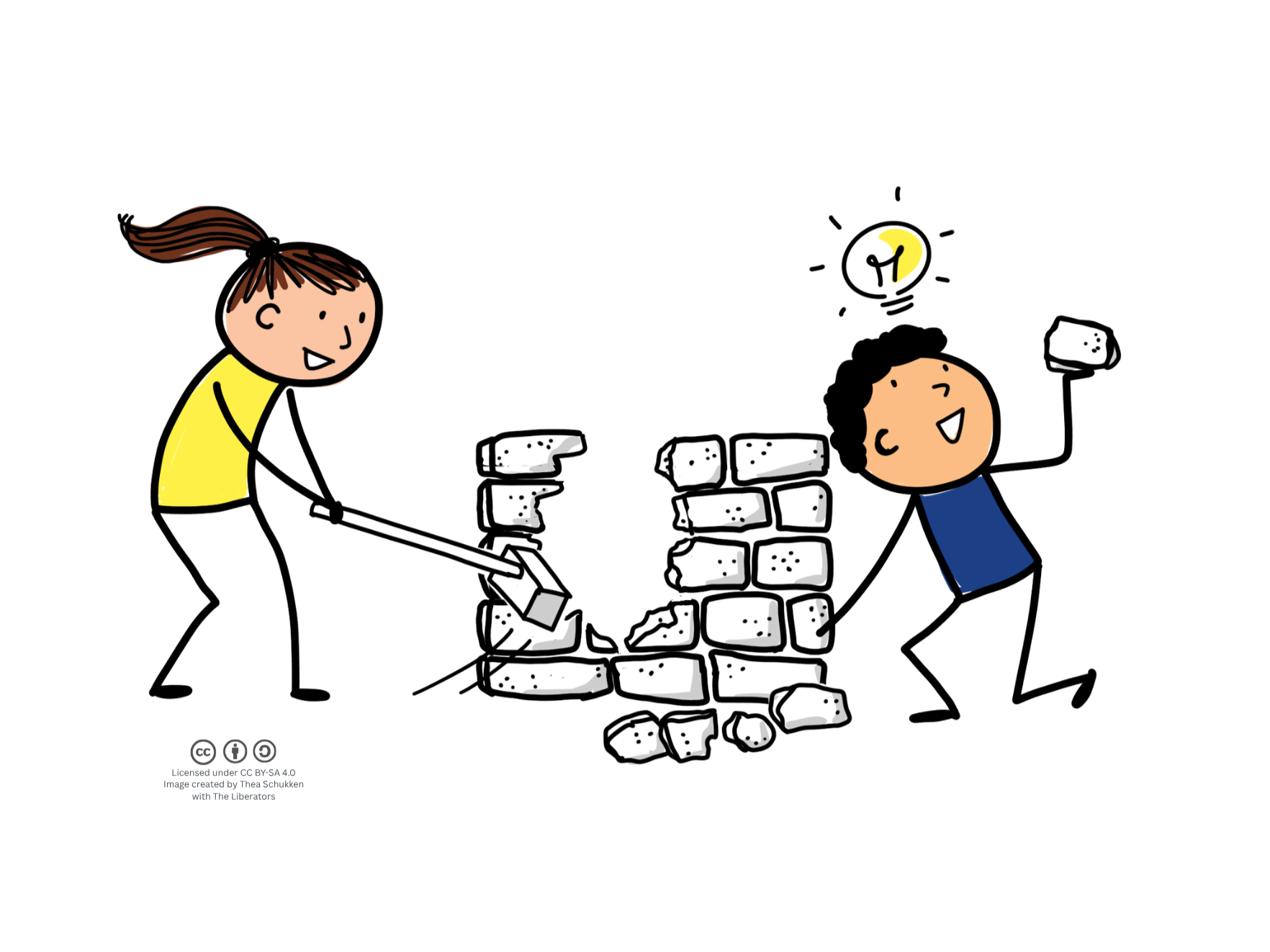
Principle: Invite Creative Destruction to Enable Innovation.
Five Structural Elements—Min Specs
Structuring Invitation
“Just like living organisms, we go through different phases of development in our activities and relationships. Today, we’re going to sort our portfolio of key activities and/or relationships into four phases and identify the roles we take in each phase. This will help us find bottlenecks and uncover opportunities to move forward.”
Space and Materials
An open wall with an Ecocycle Template, copies of the template for each F2F participant, and sticky notes [digital versions]. Groups of four chairs.
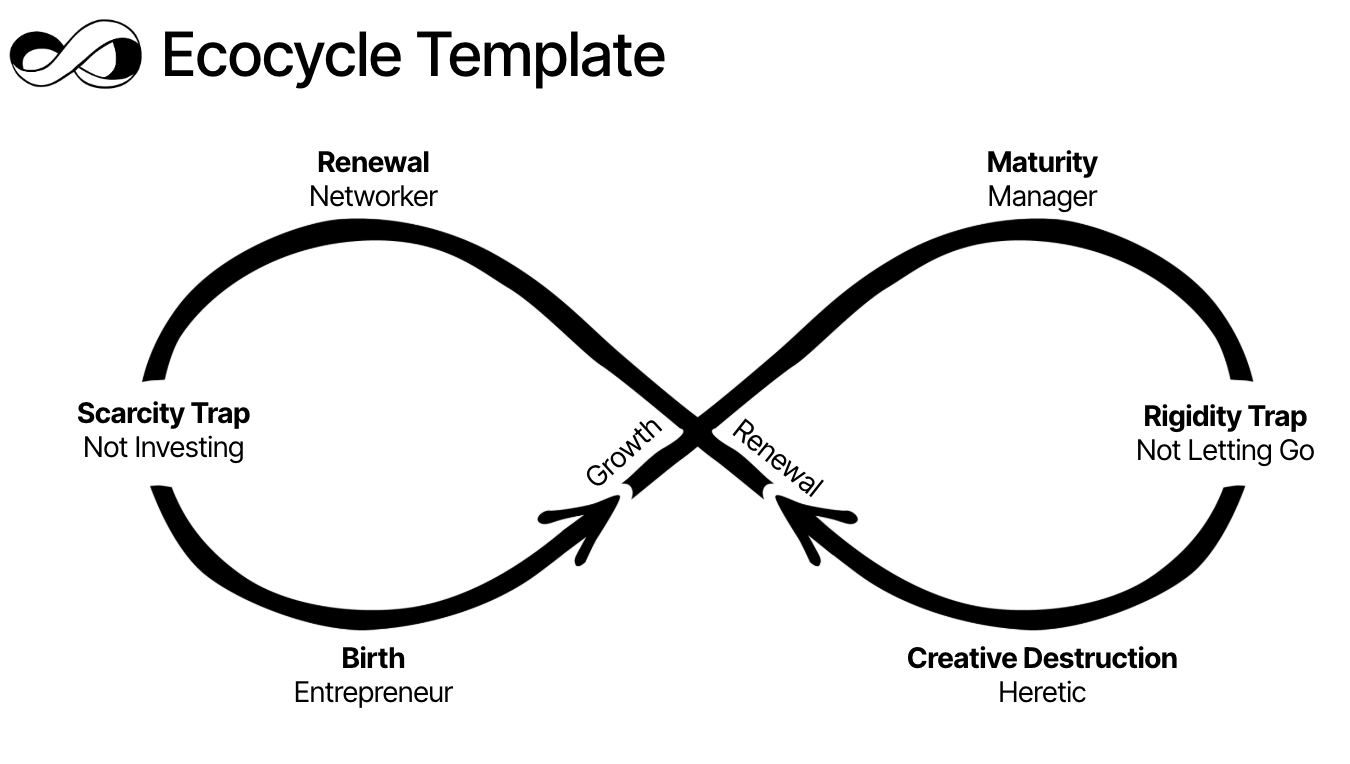
Ecocycle template for mapping a portfolio of activities and relationships.
Participation Distribution
Roles include host [tech host] and participants. There is no minimum group size. Everyone involved in the work from all levels and functions is invited and has an equal opportunity to contribute.
Group Configuration
1-2-All or [1-3-All]
Steps and Time Allocation
Intro: Share the structuring invitation and introduce the phases of the Ecocycle and actions in each.
Actions that accelerate growth during the Birth phase
Actions that extend life or increase efficiency during the Maturity phase
Actions that recycle obsolete items during the Creative Destruction phase
Actions that connect creative people and prepare the ground for birth during the Renewal phase (5 min.)
Ecocycle Walk-Through with Examples: Hand out the Ecocycle templates. Add a few familiar examples to the shared Ecocycle, such as regular meetings, using sticky notes so you can move them as the portfolio evolves.
For a meeting, ask “Are we still figuring out how to work together effectively?” (Birth); “Do we have a good rhythm and are we working efficiently?” (Maturity); “Is it time to rethink the purpose of this meeting or how we run it?” (Creative Destruction); “Are we brainstorming new, collaborative ways to improve it?” (Renewal).
For a major relationship, ask “Are we beginning to build trust?” (Birth); “Is it a strong, reliable partnership?” (Maturity); “Do we need to renegotiate terms or even consider alternatives?” (Creative Destruction); “Are we exploring new ways to collaborate and innovate?” (Renewal).
If there is a lack of agreement, break the relationship into smaller pieces (e.g., specific divisions or people in an organization). If participants still disagree, place the relationship in both phases and come back to it later. Check for questions before moving on. (5 min.)
Individual Ecocycle Mapping: Participants list major activities, projects, and initiatives from the group’s portfolio that take up their time and place sticky notes for them on their own Ecocycles. (10 min.)
Compare Ecocycles: Participants form groups of two to three [breakouts] to compare their Ecocycles and discuss differences in item placement. (10 min.)
Whole-Group Ecocycle Mapping: Everyone returns to plenary. One person from each group adds their sticky notes to the shared Ecocycle. (15 min.)
Group Reflection and Analysis: The whole group reflects on the shared Ecocycle. Ask “Which portfolio items did we agree and disagree on? What can we learn about how we’re managing our portfolio of activities/relationships? What are the implications for moving these portfolio items forward?” (15 min.)
Identify Traps: The group identifies activities in traps. Between Maturity and Creative Destruction is the Rigidity Trap, holding on to old ways even if they’re not working. Between Renewal and Birth is the Scarcity Trap, not investing enough in new ideas. Ask “What items in the Rigidity Trap do we need to let go of? What promising ideas in the Scarcity Trap should we invest more in? What other opportunities do we see?” (15 min.)
Action Steps in Small Groups: Participants form small groups of four [breakouts]. They name a first-step action for moving or ending each trapped activity and add it to the shared Ecocycle, using a specific sticky note color for actions. (10 min.)
Next Steps and Closing: Everyone returns to plenary. Decide as a group how often to revisit the Ecocycle. A few people share takeaways. (5 min.)
Taking It Online
This structure works online with no major adjustments. It works best on a large screen, as manipulating virtual sticky notes can be difficult on a phone or tablet.
Practice Insights
Focus on either activities or relationships to start. Relationships can include internal and external stakeholders. Emphasize that placements in the Ecocycle should represent the group’s current situation, not where you want to be. Don’t discourage disagreements; they can lead to insights.
Tips
Adjust the language used to describe each phase based on context. For example, a health group may understand renewal, whereas a business group may prefer reorganization. Have one person tell the story of their work by walking through the Ecocycle.
Riffs and Variations
Use an Ecocycle as a central note-taking space during strategic planning. Review a grant proposal and collectively decide what to discard. Plan changes in an individual’s personal life.
Practical Applications
Optional String
Use a different LS for developing each of the key phases of the Ecocycle. Use Panarchy or What, So What, Now What to spur action in Maturity. Revisit values with Principles Walk-Around to help manage portfolio activities and relationships.
Attribution
Adapted by Henri Lipmanowicz and Keith McCandless. Dig deeper by exploring the work of Brenda Zimmerman.
Collateral Materials
Link to supporting materials for Ecocycle Planning.
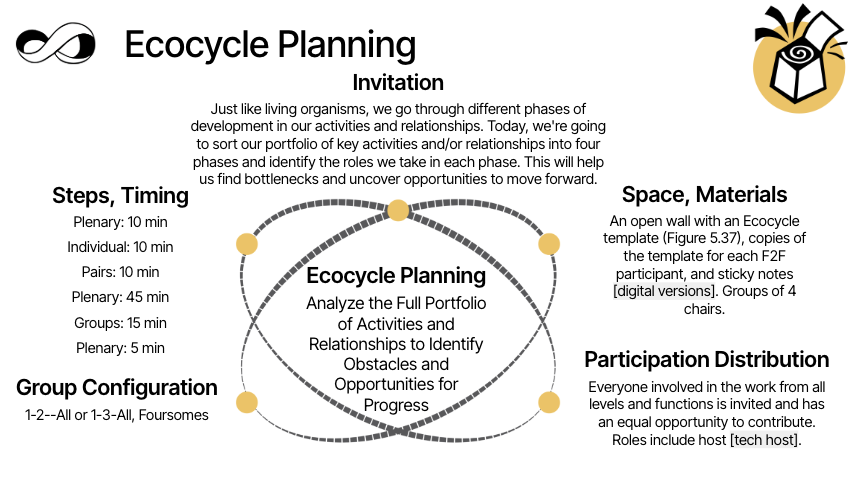
Microstructural elements of Ecocycle Planning in the constellation format.